
We're creating Matter because the structure of work is changing — and we want the change to reach everyone with an idea.
For most of history, having an idea was the easy part. Turning it into a real thing — a product, a service, a working company — was where the cost lived. Execution was the moat. The engineers, the operators, the lawyers, the marketers, the months of coordination between knowing a thing and shipping a thing — that was the bulk of what a company was.
AI is collapsing that distance. What used to take a team of twelve over a year now takes one person and a weekend. The execution moat is dissolving in real time. When execution becomes cheap, the scarce thing is the idea. The conviction. The insight. The taste. The context only you have. Value moves to the source.
The roles between the idea and the product — the engineer translating a spec into code, the designer turning a brief into a layout, the operator coordinating the supply chain, the marketer adapting the message to the audience — are not disappearing. They're consolidating into a smaller number of people working more directly. The person at the top of the chain captures more of what the chain produces.
The source — the person with the idea and the will to act on it — has historically had a name. Founder.
We're entering the era of founders.
A doubling within reach
There are roughly 400 million companies in the world today. Within a decade, that number is on track to reach a billion. Not as a stretch projection — as the trajectory of a curve already in motion.
The 600 million additional companies between today and a billion are not abstract. Each is a person somewhere acting on something only they can see. The thing every person carries — the workflow they know is broken, the language no one outside their region speaks, the supply chain only they understand, the small invention that solves one specific problem in one specific place — has always been worth doing. What has changed is the cost of doing it.
The 2023 McKinsey Global Institute analysis estimated generative AI could automate work equivalent to 60–70% of employee time across occupations. Not by removing the work, but by changing who needs to be in the room. The founder who once needed a team of twelve is now a viable solo. The team of two that would have needed twenty is now a viable small company. The math has shifted toward creation.
The trajectory is already steepening. The US Census Bureau recorded 5.5 million new business applications in 2023 — a record — and 5.2 million in 2024. The US application rate has roughly doubled in a decade. The World Bank Entrepreneurship Database shows the same curve across 188 economies.
Every previous era of economic expansion had infrastructure that enabled it. The transcontinental railroad did not cause westward expansion — it made it possible at scale. The internet did not cause the information economy — it removed the friction that had kept it small. The trajectory toward a billion has the same shape: a curve already in motion, waiting on the layer that lets it reach everyone.
This is the moment a billion is in reach.
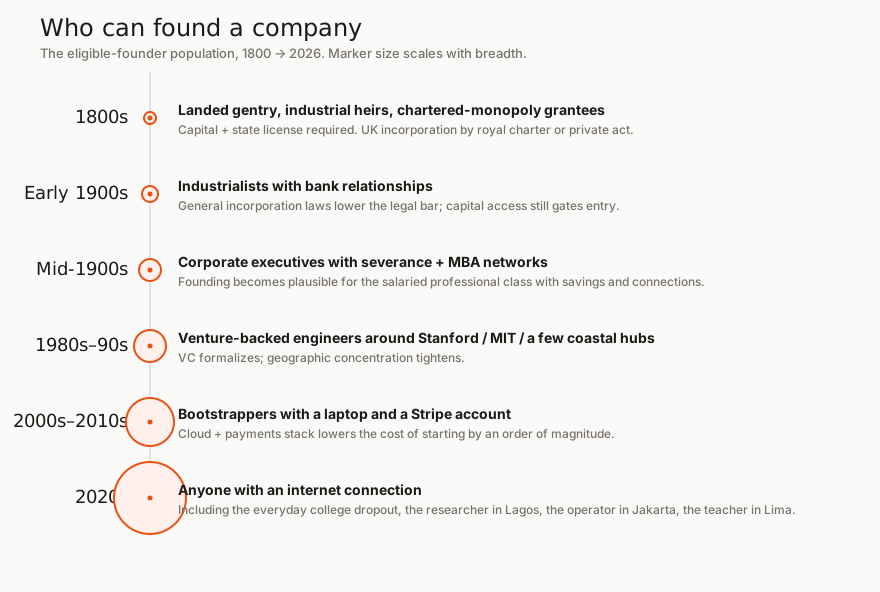
The set of people allowed to start a company has widened by an order of magnitude every century. AI is widening it again, in years.
The paradigm shift
To get to a billion, the company itself has to change shape. Today, starting and running one still feels like the mainframe era — provisioning is gated, governance is manual, dissolution is a six-month engagement. The next paradigm looks like AWS: a real legal entity provisioned in minutes, run as software, and de-provisioned just as easily when the work is done.
Getting there means agents in the loop. Agents create the company. Agents manage the cap table, the filings, the board resolutions — the administrative heartbeat no founder should have to learn from scratch. And, most importantly, agents make dissolution cheap. The default end state of a small company today is not a clean exit; it's an abandoned Delaware entity quietly accruing franchise tax for years. When dissolving is as fast as creating, the cost of trying something falls to almost nothing. Founders take more shots. The ones that don't work close cleanly. The ones that do scale into something larger.
The company should become invisible. And packageable. A working company is a folder of agreements, ledgers, filings, and obligations — today, scattered across three vendors and a shared drive. When the company is one composable, portable object, it can be moved across jurisdictions, transferred to a counterparty, or wound down in one motion. Founders stop maintaining a company; they hold one, and the company runs underneath.
This is the shift that turns "more founders" from a hope into a structural change. Not just falling cost — falling complexity. Not just easier formation — easier everything that comes after.
What we're building
We started Matter to make the shift real — to take the company off the founder's plate, so anyone, anywhere can take the plunge.
We want the company itself to be infrastructure. Present. Unobtrusive. Available. There when you need it; invisible when you don't.
The shape is create, manage, exit. Form a real legal entity in a real jurisdiction in minutes. Run it without learning what you're running — governance, filings, and reports generated, signed, and submitted as the company operates. Wind it down in one clean motion when the work is done, or hand it off cleanly to a counterparty. Real legal entities, in real jurisdictions, compliant with the law as it stands. Not wrappers. Not regulatory bets.
Every operation is accessible by Claude and other agents. Forming a company, granting equity, signing a board resolution, dissolving an entity — all reachable the same way as any other modern API, with the same surface a developer would expect. The corporate machinery becomes something a founder hands to their tools, not something they have to operate themselves.
Infrastructure alone is not enough. The change we're betting on requires more people seeing themselves as candidates for the founder seat. Matter exists to remove the friction and to widen the pool — to make founding feel like a path that's open, not one that requires permission. The companies that will be built in the next decade come from places and people the existing system was not designed to reach. We want to reach them.
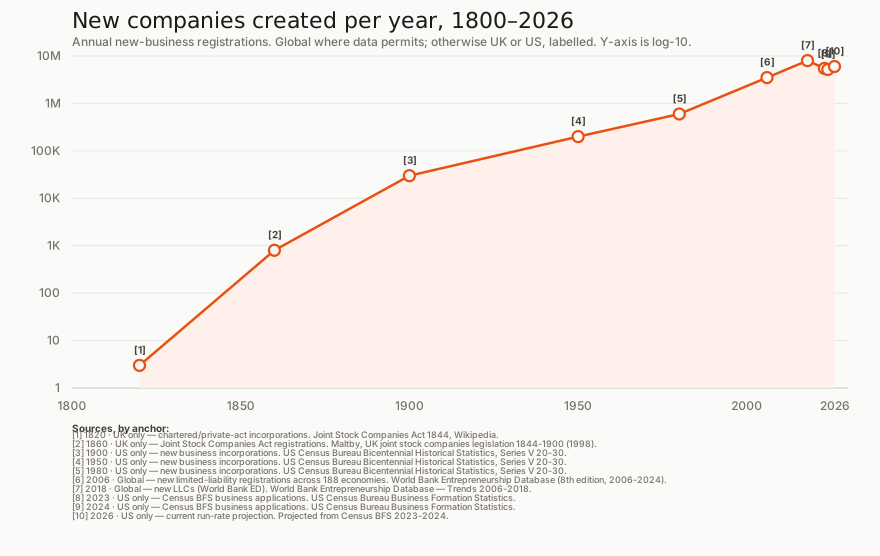
A curve two centuries in the making, bending more sharply each year creation gets cheaper.
What's next
The shape of a company keeps changing. We expect to enable companies at sizes and scales that don't exist yet — single-purpose entities that run for a quarter and exit cleanly, micro-companies built around one customer, cross-border structures that take minutes instead of weeks. Onchain rails matter here too, not as ideology but as a way to make ownership, custody, and transfer of corporate assets atomic, with the ledger, the cap table, and the governance native to the same object.
The cast widens. Solo founders today, joined by team-of-one founders augmented by agents, then by founders running companies where most of the operational work happens on the agent side — and eventually by entities where no human is in the loop. Companies started by an agent, managed by an agent, and exited by an agent. The LLC, the C-corp, the S-corp were drawn for humans in physical space, making decisions at the speed of meetings; the next legal framework adapts. Token-scoped permissions defining exactly what an agent can authorize without human co-signature. Dual-attribution signing that records which human and which model jointly produced a decision. Machine-readable articles of incorporation a system can parse and enforce. Not speculative roadmap material. Current engineering backlog.
And we expect more problems to be solved. The hard, narrow, contextual problems civilization has under-deployed against because nobody could afford to start the company that addresses them. Mental health. Infant mortality. Supply-chain transparency. Language access. The thousand small frictions in every industry that need someone close to the work to fix. When founding a company is no harder than provisioning a database, the people closest to those problems get to act on them.
We're at the start
The first version of Matter handles formation, governance, and exit for companies in the United States, in the legal frameworks that exist today — Delaware, Wyoming, the C-corps and LLCs the rest of the modern stack already speaks.
We're building toward something larger. Every jurisdiction. Every kind of company that should be possible and isn't yet. The agentic entity. The hundred-day single-purpose company. The cross-border structure formed in minutes. The companies existing legal frameworks are not yet shaped to hold — and the ones the AI era will need.
Building infrastructure takes time. AWS launched S3 in 2006; the cloud era took the better part of a decade to arrive. Stripe shipped its first API in 2011; embedded finance arrived later still. Both are now infrastructure no one thinks about — which is what infrastructure is supposed to be. Matter is at the start of the same curve.
Here is the prediction. Founder becomes the #1 job of the coming decade. Not as in "CEO of a unicorn" — as in the dominant shape of productive work. The default career, not the exception. Hundreds of millions of people running small, focused, often solo companies built around the thing only they can see. The structure of the workforce shifts. Employment doesn't disappear; it stops being the only viable path.
This isn't the prediction that everyone becomes a Hollywood director or a YouTuber. The new founders look different. The plumber who builds a tool for other plumbers. The teacher who builds a curriculum that scales. The nurse who builds the workflow software her hospital should have had. The retired engineer who builds the part nobody is making anymore. Each running a real legal entity, with real customers, real revenue, and a real footprint — small companies in the long tail, not flagship companies in the spotlight.
Here is the call. If you have an idea, take it. The cost has collapsed. The infrastructure is being built. The cultural permission is widening. The thing you carry that nobody else can build is more valuable now than it was a decade ago, and it will be more valuable still a decade from now.
Four hundred million companies today. A billion within the decade. Each one a person, somewhere, acting on something only they can see.
The era of founders is here. We're building the infrastructure to make sure it reaches everyone.
Sources
McKinsey Global Institute — The economic potential of generative AI (2023)
World Bank — Entrepreneurship Database (new businesses registered, 188 economies, 2006–2024)
US Census Bureau — Bicentennial Historical Statistics of the United States, Colonial Times to 1970
UK Joint Stock Companies Act 1844 — first public companies registry
Share this post